Choosing the right internet for your home is more critical than ever. With the rise of remote work, streaming, and online gaming, deciding between 5G Home Internet vs Fiber can affect speed, reliability, and cost. In this guide, we compare these two technologies in detail to help you make the right decision for 2026.
Table of Contents
- Overview of 5G Home Internet
- Overview of Fiber Internet
- Speed Comparison: 5G vs Fiber
- Reliability and Latency
- Pricing and Plans
- Installation and Availability
- Comparison Table
- How to Choose the Right Internet
- Tips for Getting the Best Deal
- FAQs
Overview of 5G Home Internet
5G Home Internet delivers wireless high-speed connectivity using 5G mobile networks. It allows homes to connect without the need for traditional wired infrastructure. Providers like T-Mobile, Verizon, and AT&T now offer 5G home internet plans designed for streaming, gaming, and working from home.
Key features of 5G Home Internet:
- Wireless connectivity, easy installation
- Speeds typically between 100 Mbps and 500 Mbps
- Low latency suitable for most online activities
- Flexible plans, often with unlimited data
Overview of Fiber Internet
Fiber Internet uses optical fiber cables to deliver extremely fast and reliable broadband. Known for symmetrical upload and download speeds, fiber is ideal for households with multiple users or heavy data needs.
Key features of Fiber Internet:
- High-speed connectivity up to 1 Gbps or more
- Symmetrical upload and download speeds
- Reliable and low-latency connection
- Available in select urban and suburban areas
Speed Comparison: 5G vs Fiber
Speed is one of the main considerations when comparing 5G Home Internet vs Fiber.
5G Home Internet Speeds
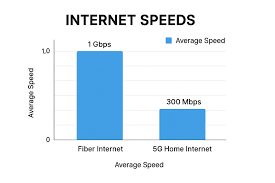
- Average speeds: 100–500 Mbps
- Speeds fluctuate based on network congestion and location
- Download speeds usually higher than upload speeds
Fiber Internet Speeds
- Average speeds: 300 Mbps–1 Gbps
- Symmetrical upload and download speeds
- Consistent speeds regardless of network congestion
Overall, fiber typically provides higher and more consistent speeds than 5G, especially for households with multiple users.
Reliability and Latency
Reliability and latency are crucial for online gaming, video conferencing, and streaming. Here’s how 5G and fiber compare:
5G Home Internet
- Wireless, so signal can be affected by distance and obstacles
- Low latency, but can increase during peak hours
- Good for general use, streaming, and work from home
Fiber Internet
- Wired connection ensures stable speeds and minimal interference
- Extremely low latency, ideal for gaming and video calls
- Highly reliable, even during high-traffic times
For users who prioritize consistency, fiber tends to outperform 5G in reliability and latency.
Pricing and Plans
Cost can influence your decision between 5G Home Internet vs Fiber. Here’s a general overview:
5G Home Internet
- Monthly plans: $50–$70
- Easy installation, often no contracts
- Unlimited data options available
- Best for flexibility and avoiding installation costs
Fiber Internet
- Monthly plans: $40–$100 depending on speed
- Installation may require professional setup
- Symmetrical speeds and unlimited data common
- Long-term contracts may apply
5G can be cheaper upfront with easier setup, but fiber offers better long-term speed and value.
Installation and Availability
Availability can make or break your choice between 5G Home Internet vs Fiber.
5G Home Internet
- Easy, plug-and-play installation
- Coverage depends on 5G network in your area
- Widely available in urban and suburban locations
Fiber Internet
- Professional installation required
- Limited to areas with fiber infrastructure
- Availability increasing but still less widespread than 5G
If you live in an area without fiber, 5G may be the only viable high-speed option.
Comparison Table: 5G Home Internet vs Fiber
| Feature | 5G Home Internet | Fiber Internet |
|---|---|---|
| Connection Type | Wireless | Wired (optical fiber) |
| Speeds | 100–500 Mbps | 300 Mbps–1 Gbps |
| Latency | Low, variable | Very low, consistent |
| Reliability | Good, affected by distance/obstacles | High, stable even during peak hours |
| Installation | Plug-and-play | Professional required |
| Availability | Expanding, urban/suburban areas | Limited to fiber infrastructure areas |
| Cost | $50–$70/month | $40–$100/month |
How to Choose the Right Internet
To decide between 5G Home Internet vs Fiber, consider the following:
- Check availability in your area
- Determine your speed and latency requirements
- Consider the number of devices and users
- Compare upfront installation costs and monthly pricing
- Evaluate long-term reliability and potential upgrades
Tips for Getting the Best Deal
- Look for promotional rates for new customers
- Check bundled options with TV or phone services
- Negotiate with providers for discounts or waived fees
- Consider pre-paid or no-contract plans for flexibility
- Monitor for data throttling or speed caps
FAQs
Is 5G Home Internet faster than fiber?
Fiber generally provides faster and more consistent speeds, although 5G can be competitive in areas with strong coverage.
Can 5G replace fiber at home?
It can for many households, especially where fiber isn’t available, but fiber remains superior for heavy usage and low latency needs.
Which is cheaper, 5G Home Internet or Fiber?
5G often has lower upfront costs and easier installation, but fiber may offer better long-term value for high-speed requirements.
Is fiber more reliable than 5G?
Yes, fiber offers stable speeds and very low latency, while 5G can fluctuate based on network traffic and distance from towers.
Can I use 5G as a home internet solution?
Yes, 5G Home Internet is designed for households needing high-speed wireless internet without wired connections.
Which is better for gaming?
Fiber is usually better due to lower latency and consistent speeds, but 5G can still support casual and competitive gaming in strong coverage areas.
Do both options offer unlimited data?
Many fiber plans and 5G home internet plans now offer unlimited data, but always verify with your provider.
Final Thoughts
When deciding between 5G Home Internet vs Fiber, your choice depends on speed requirements, reliability, availability, and budget. 5G offers flexible, wireless installation with competitive speeds, making it ideal for urban and suburban households without fiber. Fiber provides superior performance, symmetrical speeds, and unmatched reliability for heavy users and multi-device households. By comparing these factors, you can select the best option for your home or work setup in 2026.


Leave a Reply